Spark: the Financial Times' newsroom publishing suite
The challenge
Every day at the Financial Times starts with the same question repeated across a dozen desks: what’s the news agenda, who’s covering what, and where does it actually get written, checked and published? Before Spark, the answer lived across a patchwork of tools that hadn’t kept pace with how a modern newsroom works: planning in one place, writing in another, incoming wire copy somewhere else again, and freelance contributor payments running through a complex Salesforce system nobody enjoyed using.
The brief was to design Spark, a single connected suite of newsroom tools covering planning, curation, content management, wire feeds and contributor payments, built as one coherent system with a shared design language, not five separate products that happened to share a login.
What we did
We inherited Spark Stories, the FT’s fully-featured CMS, and worked with the Spark team (eight developers, two product managers and a delivery manager) to design and test a stream of enhancements and extended functionality on top of it. We designed every other app in the suite from the ground up: Plans, Lists, Wires and Contributors.
We kept a standing pool of editorial users (journalists, editors, and staff from the picture, graphics and video desks) who we came back to again and again, so every module (and every enhancement to it) was shaped by the people actually running a news day, not by assumption.
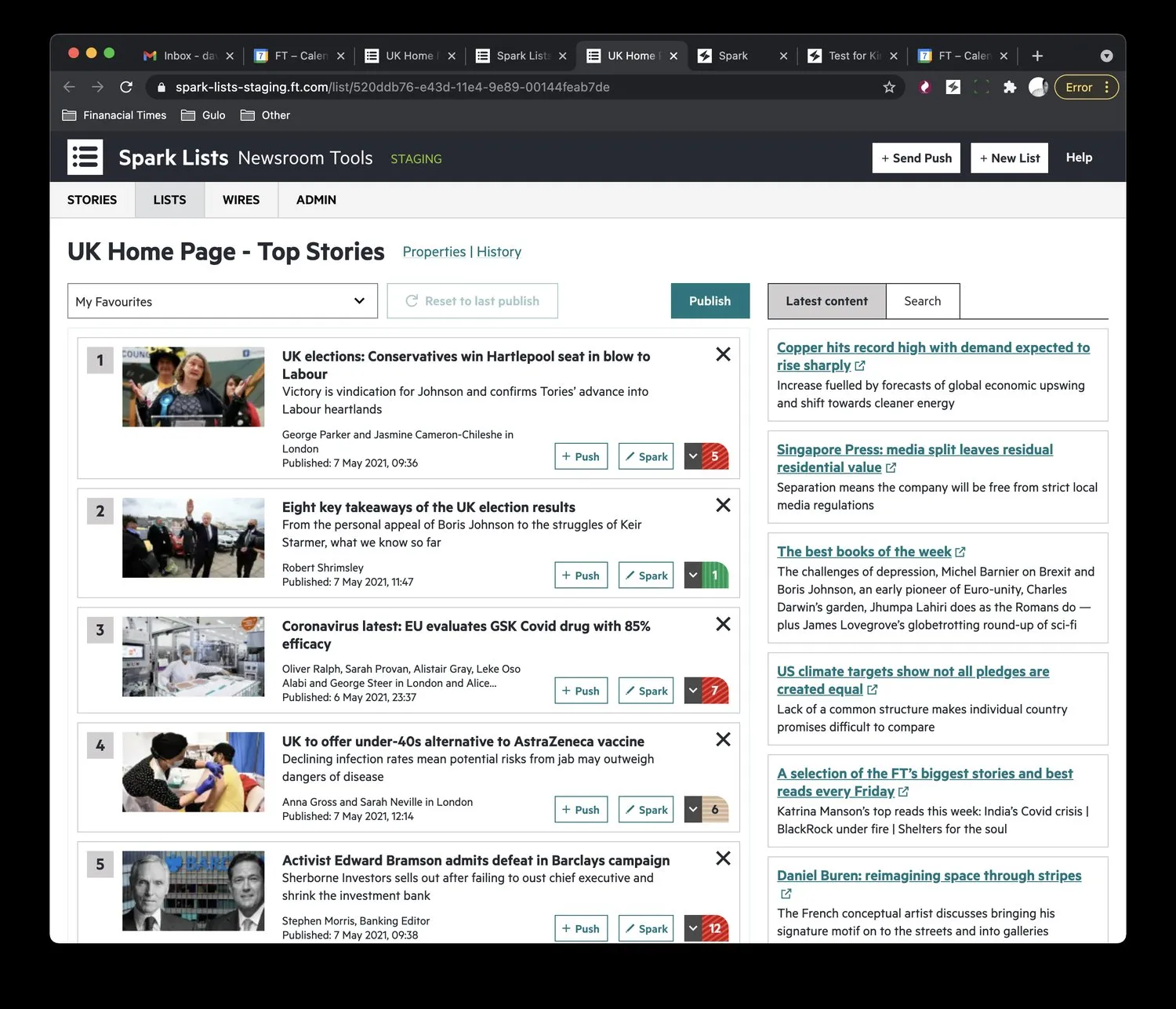
Spark Lists is where editors curate and reorder what actually appears on the homepage and section fronts as a news day unfolds: drag-and-drop story slots, live story counts and lock indicators so two editors don’t collide on the same list.
Spark Stories is the CMS itself: where journalists write, schedule and publish, with structured filters by desk, status and content type so a busy news list stays usable rather than becoming an unsorted queue.
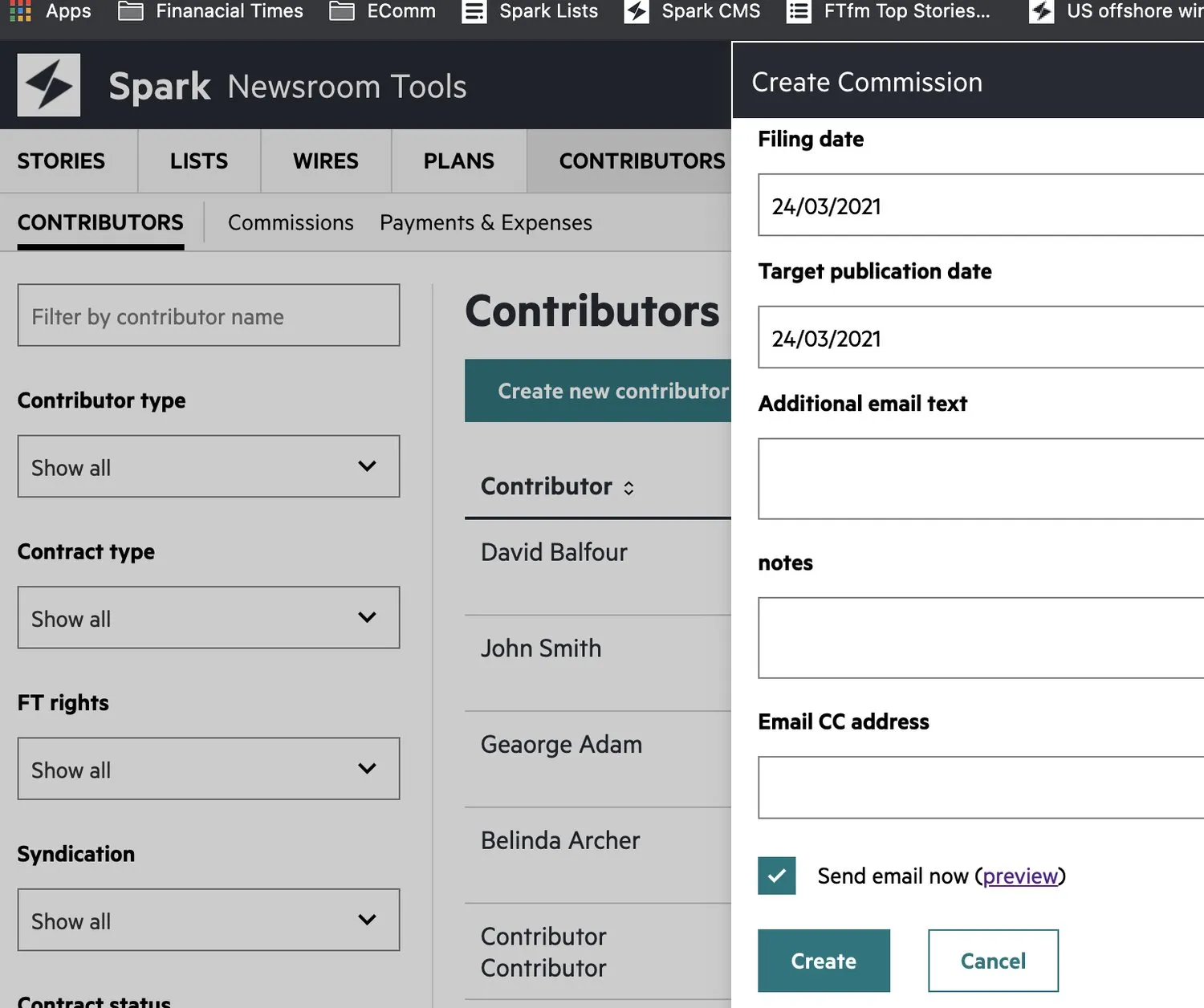
Spark Contributors replaced an extremely complex Salesforce system with something built directly into the suite: commissioning a piece of freelance work, tracking its payment status, and managing contributor rights and syndication terms, without leaving Spark.
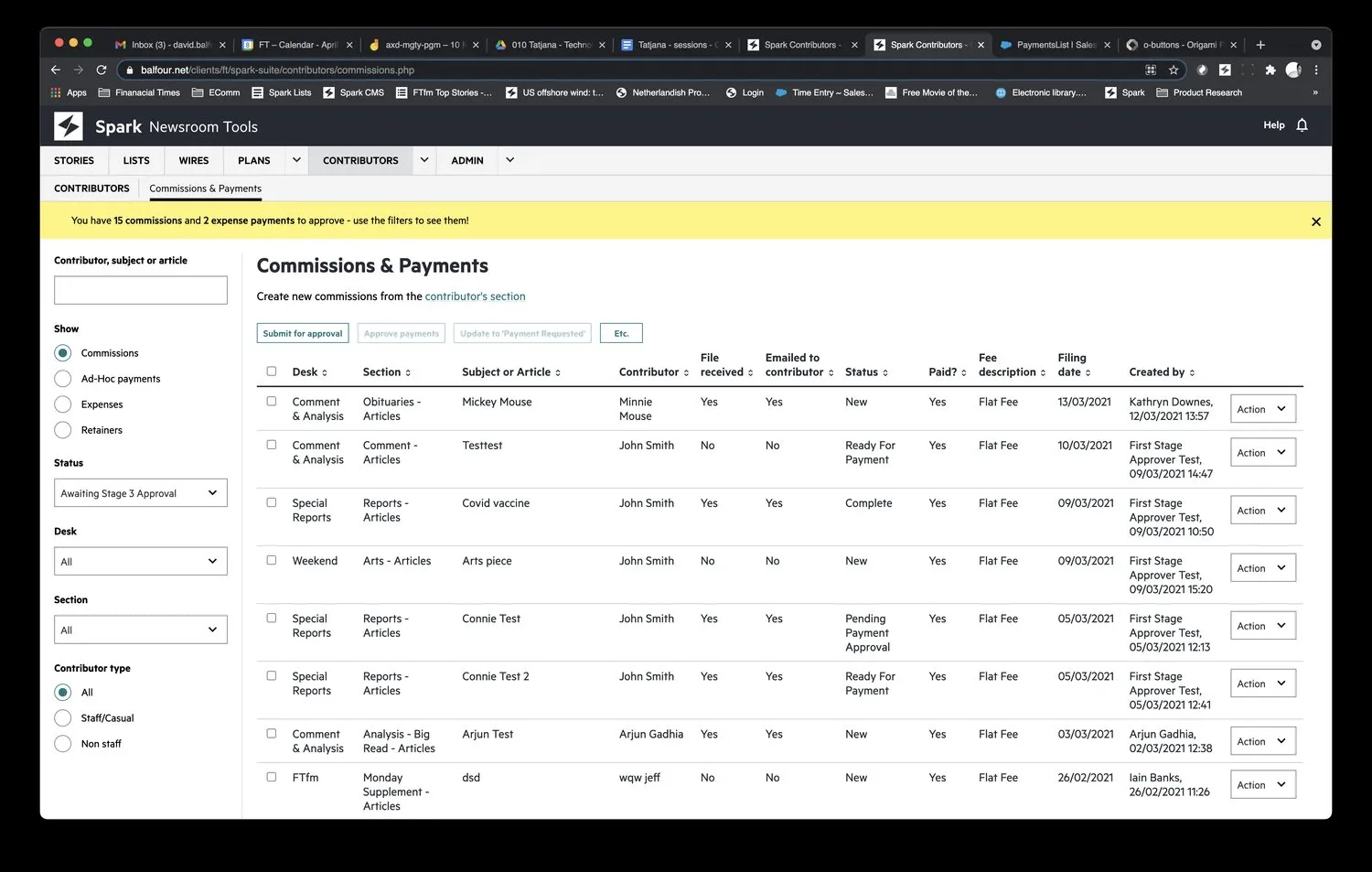
Commissioning is only half of paying a contributor properly. The other half is tracking that commission through to payment without it quietly stalling. The Commissions & Payments view gives editors and finance a shared, filterable line of sight across every commission in flight: who filed it, what desk it’s against, whether it’s awaited, ready for payment or complete.
On the curation side, Spark Lists gives editors a live, visual layout of a homepage or section front, built from the same story pool the CMS produces, with no rekeying headlines or bylines between systems.
Here’s a short walkthrough of the suite in action, a coded prototype built to demonstrate how the modules connect:
The result
Spark was tested directly with the people who use it every day, rather than validated in the abstract. A survey of the editorial staff who rely on it put overall satisfaction above 90%, across 120 respondents. That is a strong result for a suite that replaced tools a newsroom depends on hour to hour, and one that reflects five years of iterating directly against editorial feedback rather than a single big-bang redesign.
← Back to all case studies