Spark Plans: replacing Asana as the FT's news planning tool
The challenge
Before Spark Plans, the FT planned its news agenda in Asana, a general-purpose project tool doing a very specific job it was never designed for. It worked, under constraints, but it wasn’t loved: Asana couldn’t integrate the FT’s own metadata, searching across multiple views was limited, and news editors had no complete view of everything being planned under a single storyline: a running story like the Wirecard scandal or an election could be scattered across boards with no single place that showed it all. Worse, planning in Asana meant a second copy of information that also lived (or would eventually live) in Spark itself, so editors were duplicating their own work by hand.
The brief wasn’t simply “rebuild Asana inside Spark.” It was to ask what planning could look like if it were designed as a native part of the same system journalists already wrote and published in, and to prove that with real editorial users before committing to build it.
What we did
Kick off and understand
We opened with a workshop bringing editorial staff, stakeholders and the product team together to agree goals, a shared vision and next steps. From there we ran semi-structured interviews with the desks who’d actually use the tool day to day: news desks, editors, and the picture, graphics and video desks, with a dedicated note-taker so we could stay focused on the conversation rather than the transcript.
That research surfaced a clear, if slightly contradictory, picture. Editors valued things Asana genuinely did well: its lists were easy to scan, its scheduler UI beat Spark’s own at the time, and staff liked being able to see everything everyone else was doing in one place. But the same editors described planning in Asana as too complex and too time-consuming for most people, longer-term planning mostly happened outside Asana in calendars and documents and only got added once a story was commissioned, and the picture and graphics request process was too slow for the people fielding those requests. The goals that came out of that synthesis were concrete: make planning easier, less time-consuming and less duplicative; make it a seamless part of the content-creation process already happening in Spark; and improve communication around the news agenda rather than fragmenting it further.
Generate ideas
With the problems and personas clear, we ran ideation across three remote sessions rather than one long one, deliberately, so participants had time to reflect between sessions rather than being asked to solve everything in a single sitting. We set homework between sessions too: participants sketched their own ideas and dropped them directly into a shared slide deck ahead of the next call.
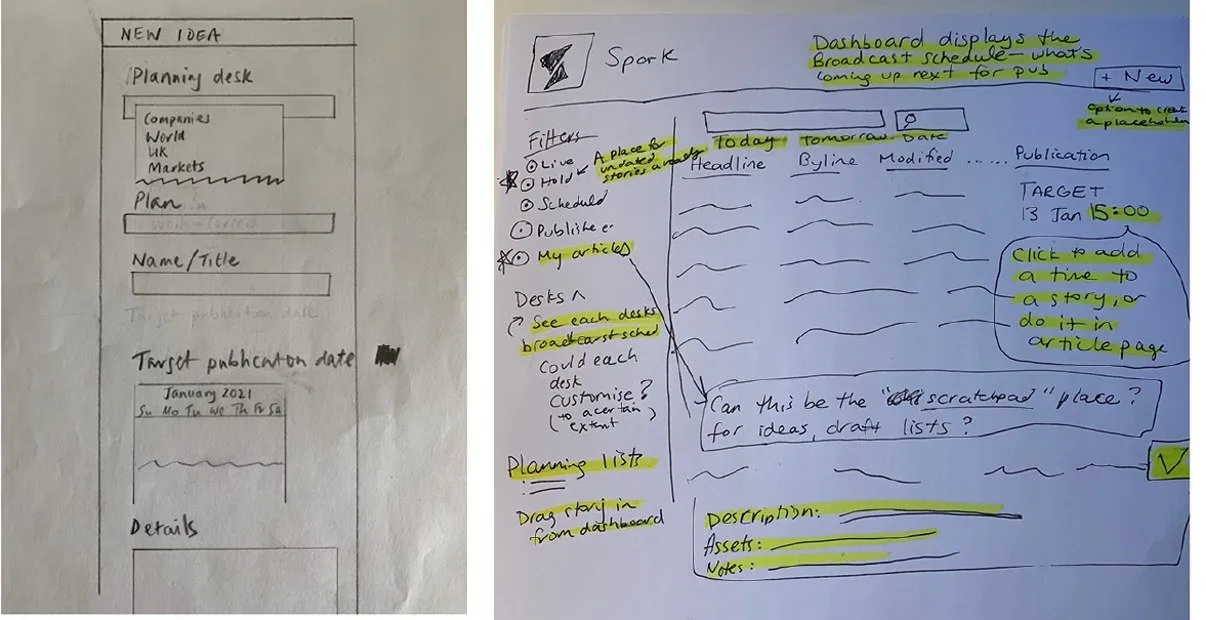
Design and run experiments
This phase was about validating our ideas and assumptions with the people who’d actually use the tool, not defending them. We used Miro to map flows and built working mockups and a prototype in code using the FT’s own design system, Origami, so what editors were reacting to already felt and behaved like a real FT product rather than a static picture of one. We ran sessions with users from the Understand phase and iterated quickly toward a design that worked for as many of them as possible.
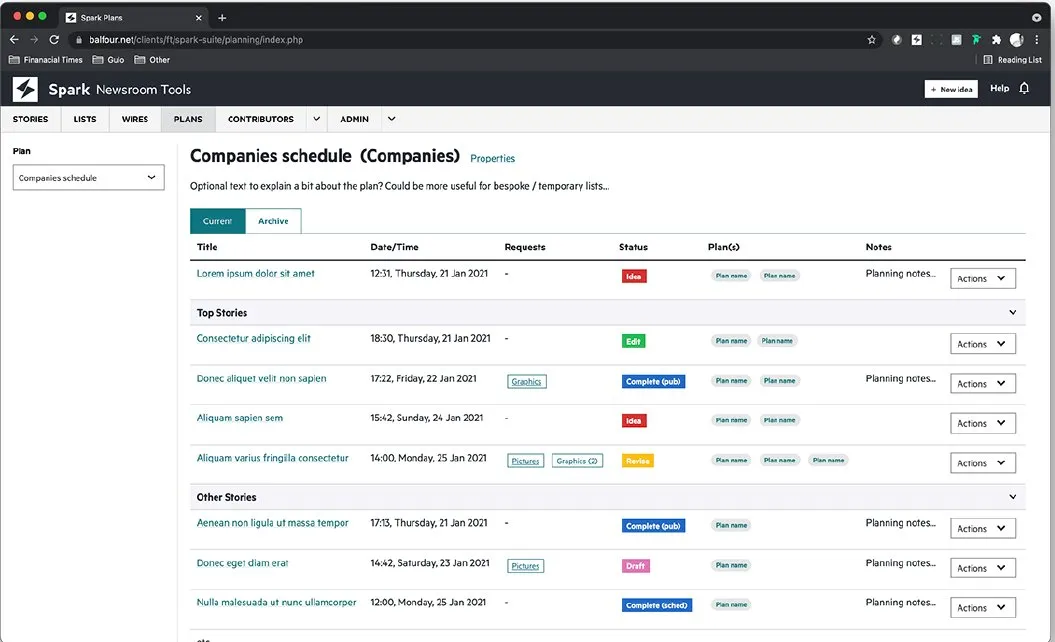
The result replaced Asana’s generic project boards with planning views built around how the FT actually organises coverage: grouped by section (Companies, World, UK, Markets and so on), with a clear status per item (Idea, Edit, Complete, Draft, Revise) and, critically, direct links out to the requests and stories that item is connected to.
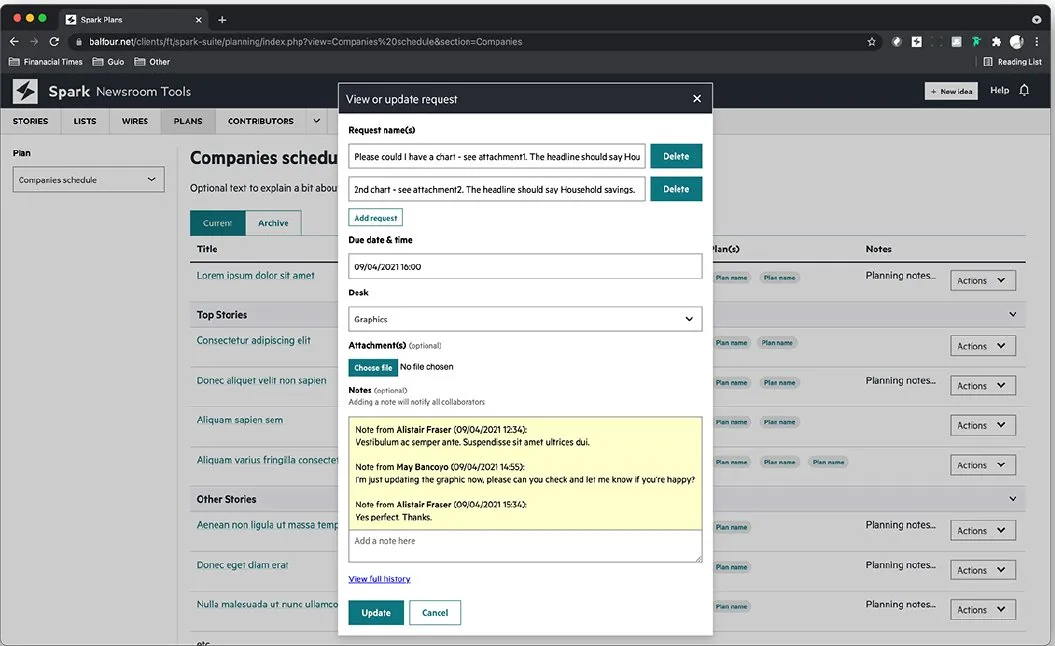
One of the sharpest pain points from discovery was the picture and graphics request process: too slow, and disconnected from the story it was supporting. Spark Plans put the request itself, and the back-and-forth about it, on the same screen as the planning item: a collaborator can raise a request, attach a reference file, and thread notes with whoever’s fulfilling it without leaving the plan.
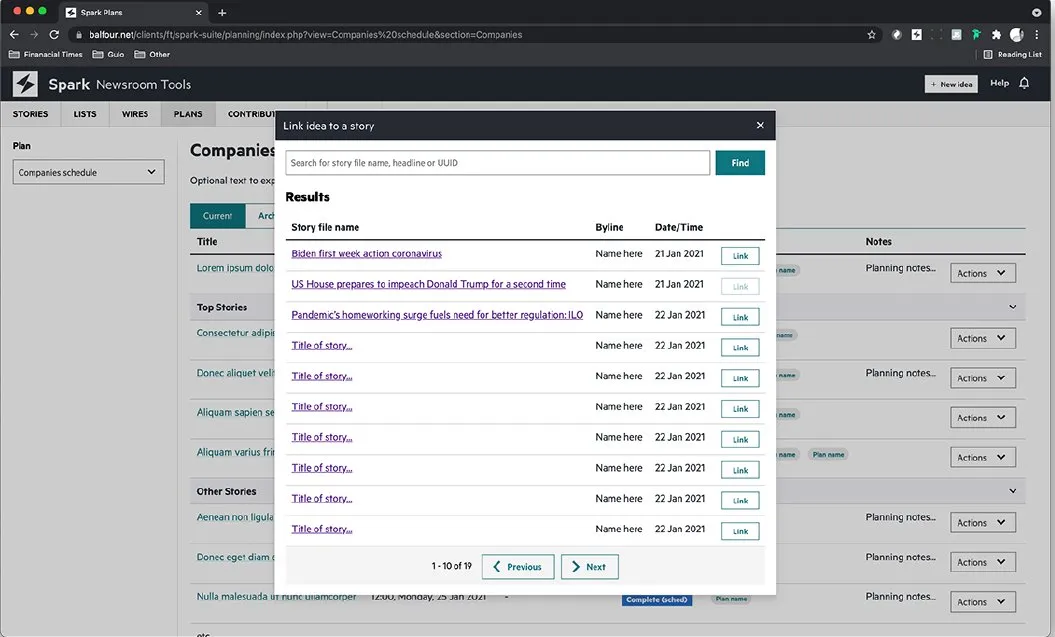
The other major pain point (duplicating work between Asana and Spark itself) was solved by making the two systems the same system. An idea in Plans can be linked directly to its live story file in Spark Stories, so there’s one source of truth rather than two copies to keep in sync by hand.
The result
Spark Plans rolled out fully at the end of 2022, replacing Asana as the FT’s news planning tool. It’s part of the wider Spark suite. See the Spark case study for how planning connects to the CMS, wires and contributor tools around it.
← Back to all case studies